




On July 24, 2026, the new forced-labor tariff went into effect: an additional 10% on Mexican goods entering the United States. Put that way, the news sounds like a direct blow to export costs. The reality is more nuanced and, at the same time, more demanding: most Mexican trade is exempt from this tariff, but only if each shipment is properly documented. The difference between paying and not paying is no longer a matter of country but has become a matter of file.
In a nutshell: The United States imposed a 10% tariff on Mexico under Section 301, on the grounds that Mexico does not effectively enforce the ban on importing goods made with forced labor. The goods that enter Goods that are duty-free under the USMCA are exempt from that tax, and that covers about 85% of Mexican exports. The key lies in the verb: it is not enough for the goods to might qualify; you must claim preferential treatment and support it with a valid certificate of origin.
What Changed with the Forced Labor Tariff on July 24, 2026
The Office of the United States Trade Representative (USTR) closed 60 investigations that had been opened in March 2026 regarding the failure to impose or effectively enforce bans on trade in goods produced using forced labor. The result was an additional tariff for all of those economies: 10% for countries that already have a ban, a partial regime, or a commitment under a reciprocal trade agreement, and 12.5% As for the rest, Mexico was placed in the first group.
The measure applies to goods declared for release into the domestic market as of 12:01 a.m. Eastern Time on July 24, 2026. This is a country-wide tariff, not a sector-specific one: it applies to all products in the economy under investigation, except for the exemptions listed in the annexes to the resolution.
However, for Mexico, the practical impact was less than the headline suggested. This 10% replaced which was already being applied under Section 122, the validity of which expired on that very day. The legal basis changed, not the rate. The Ministry of Economy summarized it this way in its press release:
"One replaces the other, so the tariff treatment remains the same." According to the agency, approximately 85% of Mexican exports to the United States continue to enter duty-free under the USMCA.
There is a fundamental difference between the two instruments that should not be overlooked: Section 122 had a limited term established by law. Section 301 has no fixed expiration date. What was once temporary has become indefinite.
The exemption exists, but it does not apply automatically
Here is the point that is most often misunderstood. The U.S. resolution exempts goods from Mexico and Canada from the tariff that enter duty-free under the USMCA. The text is precise in a nuance that changes everything: to be eligible Eligibility for a preferential program does not, in and of itself, protect the goods. What protects them is that the preferential treatment was actually claimed upon entry.
"Eligible" is not the same as "exempt."
For years, many Mexican exporters did not bother to certify the origin of their products for one simple reason: the most-favored-nation tariff for that product category was already zero, so claiming the treaty’s preferential treatment did not change the amount they had to pay. It was paperwork with no immediate benefit.
That calculation was reversed. Today, a good that qualifies as originating but enters without claiming preferential treatment under the USMCA is subject to the 10% tariff, even though technically it could have avoided it under the hub tariff. The cost of not certifying is no longer zero.
Certification of Origin: Nine Key Factors
The USMCA operates under a system of self-certification. There is no need to go to any government agency or fill out an official form: the certification may be included on the invoice or any commercial document, provided it contains the nine minimum elements listed in Annex 5-A of the treaty. It may be completed by the exporter, the producer, or the importer.
These elements are: who certifies (exporter, producer, or importer), the details of the certifier, the exporter, the producer, and the importer; the description and six-digit tariff classification of the goods under the Harmonized System; the rule of origin in accordance with Article 4.2; the period covered; and, finally, the signature and date.
Three details in the fine print that, in practice, determine the outcome of transactions:
- Certification It is valid for four years From the date of issuance, it may cover a single shipment or multiple shipments of identical goods within a period not exceeding twelve months. When properly planned, an annual certification covers the entire recurring operation.
- A tariff classification error A six-digit number can invalidate the entire document. It is not an administrative detail: it is the detail on which the origin criterion depends.
- A valid certification It cannot be rejected on the basis of minor errors. If the authority deems it illegible or incorrectly filled out, you have five business days to correct it and resubmit it. Being aware of this deadline prevents you from losing your priority due to a formal omission.
Issuing a certification without having the technical file to back it up is a high-risk practice: the person who signs it assumes legal responsibility for the statements made and must be able to substantiate them during a verification visit. That is why coordination with the entity that operates the customs brokerage firm and with the department of legal consulting This must occur before the document is issued, not when the request is received.
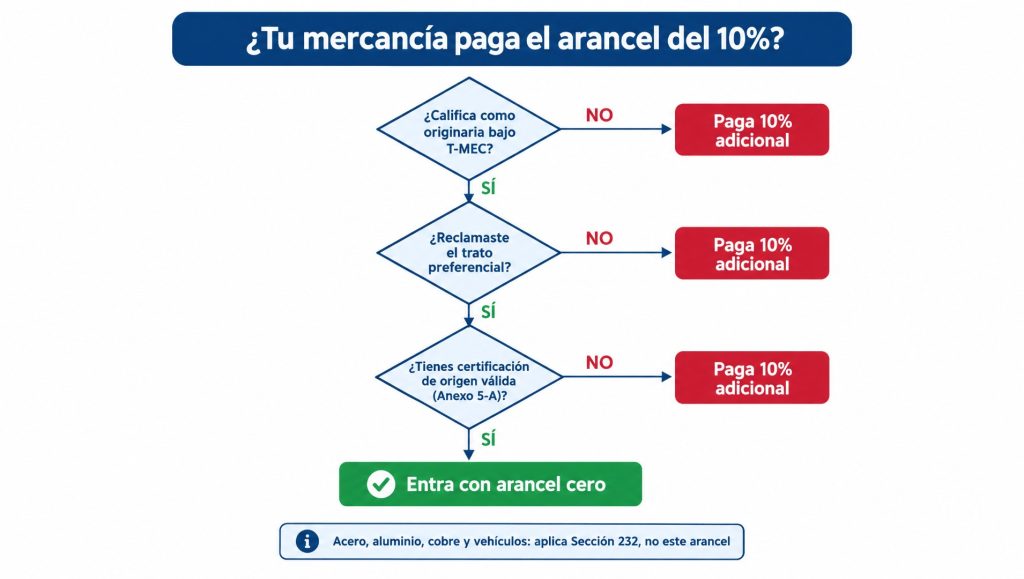
Decision tree to determine whether a Mexican product pays the additional 10% Section 301 tariff or enters duty-free under USMCA
What the USMCA exemption does not cover
It's important to be clear about the limits, because that's where unexpected costs can arise.
The Section 232 measures are proceeding on their own course. Steel, aluminum, and copper are subject to tariffs of up to 50% of the customs value, and vehicles are subject to 25%, regardless of whether the goods comply with the treaty. These products are exempt from the forced labor tariff, but not because they are exempt from all tariffs—rather, they are already taxed under a different scheme. For those who import steel products, the cost calculation is based on Section 232, not Section 301.
Anything that does not qualify as originating must be paid for. That remaining 15% of Mexican exports that do not meet the rules of origin faces an additional 10%. In many cases, these are not products outside the scope of the treaty, but rather goods that could qualify but fail to provide proof: poorly documented inputs from third countries, regional content that no one recalculated after a change in supplier, or expired certifications that continued to be used out of habit.
The Second Front: Your Supply Chain
It would be a mistake to view this measure solely as a tariff issue. The basis for Section 301 is forced labor, and that same issue is addressed through much more aggressive enforcement measures at the border.
On June 9, 2026, U.S. Customs and Border Protection (CBP) published consolidated operational guidance for importers that brings together the three tools it uses to block goods produced through forced labor: the general prohibition under Section 1307 of Title 19, the UFLPA law regarding the Xinjiang region, and the provisions of CAATSA. The guidance is explicit on a point worth emphasizing: the focus is on due diligence before It's important to act before the container comes to a stop, not after.
The process is rigorous. If the authorities suspect that a shipment contains goods of restricted origin, they detain it, and it is up to the importer to demonstrate, with clear and convincing evidence, that the goods were not produced using forced labor. The deadline for gathering and submitting that evidence is measured in days, not weeks, and the burden of proof rests entirely with the importer.
The sectors with the greatest exposure are those that incorporate components from various countries: textiles, chemicals, and electronics. A Mexican company that assembles products using Asian components can fully comply with the USMCA’s rules of origin and still face a hold due to the origin of a single component. These are two separate inspections of the same shipment.
What to Check Now
A short list, in order of urgency:
- Verify that you are claiming preferential treatment. It sounds obvious, but it’s the most common finding: originating goods entering the country without invoking the USMCA because, historically, it wasn’t necessary.
- Check expiration dates. Certifications issued more than four years ago, or aggregate periods that have already expired, leave transactions unaccounted for without anyone noticing.
- Recalculate the origin after changes in suppliers. A change in raw materials may cause the regional content to fall below the threshold without requiring a new certification.
- Validate the six-digit tariff classification contrary to the declared country of origin. This error invalidates entire documents.
- Trace the actual source of critical inputs and keep the documentation proving it. This is no longer just a matter of origin; it is what is required in a case involving forced labor.
- Keep the file for five years. This is the minimum retention period for import documentation.
One final point that carries more weight today than it did before: working with an agency certified as Operador Económico Autorizado (OEA) Compliance with SAT involves security, document control, and traceability processes that have already been validated by the authority. In an environment where the focus has shifted from the product to the dossier, having that documented control is no longer a differentiator but rather becomes basic infrastructure for exporting.
Frequently Asked Questions
Does the 10% tariff apply to all Mexican exports to the United States?
No. Goods entering duty-free under the USMCA are excluded. According to the Ministry of Economy, this accounts for approximately 85% of Mexican exports. The 10% figure applies to goods that do not meet rules of origin.
If my product qualifies as originating, am I automatically exempt?
No. The exemption applies to merchandise that actually enter duty-free under the treaty. Being eligible is not enough: you must claim the preferential treatment and support it with a valid certificate of origin in accordance with Annex 5-A.
What must the USMCA certificate of origin include?
The nine minimum elements listed in Annex 5-A: who certifies, details of the certifier, exporter, producer, and importer, description and six-digit tariff classification, rules of origin, coverage period, signature, and date. No official format is required, and this information may be included on the invoice.
Do steel and aluminum account for this additional 10%?
Not under Section 301. Those products are subject to Section 232 measures, with tariffs of up to 50% of the customs value, which apply even if the merchandise complies with the USMCA.
How long will this fee be in effect?
There is no fixed time limit. Unlike Section 122, which had a time limit established by law, measures under Section 301 do not automatically expire and remain in effect until the U.S. authority determines otherwise.
The fundamental change isn’t in the rate, which remained the same for Mexico. It’s that the window for operating without flawless documentation has closed. Previously, an incomplete file was considered an administrative observation; today, it results in a 10% penalty based on the invoice value. Companies that already had their certifications in order barely noticed the change on July 24. The rest will notice it shipment by shipment.
Sources
- Office of the United States Trade Representative. Notice of Action — Section 301 Forced Labor Investigations (July 23, 2026).
- Federal Register. Notice of Actions in Section 301 Investigations, dockets USTR-2026-0265 and USTR-2026-0266.
- USTR. USTR Issues Findings and Proposes Action in 60 Section 301 Investigations (June 2, 2026).
- Ministry of Economy. Mexico will work with the United States and present its arguments regarding the USTR's proposal.
- Government of Mexico. USMCA, Chapter 5: Rules of Origin and Annex 5-A.
- U.S. Customs and Border Protection. Operational Guidance on Forced Labor Enforcement for Importers (June 9, 2026) and Compliance with Forced Labor Laws.
- SAT. Benefits of Registering with the Business Certification Program (OEA).