





How nearshoring—or nearshoring—is transforming logistics, foreign trade, and vocational training in Mexico. We will examine how the need for highly skilled workers is emerging, what gaps exist, and how the sector can respond through education, certifications, and strategic adaptation.
Nearshoring as an economic driver and generator of skilled jobs
The nearshoring, which involves moving manufacturing or service operations closer to the end market, has established itself as a key strategy for multinational companies. This trend helps reduce logistics costs, mitigate geopolitical risks, and speed up delivery times, especially to the United States. Mexico has positioned itself as the leading destination due to its strategic location, network of trade agreements, and established manufacturing expertise (Source: CES Mexico City, The Logistics World).
Tangible Growth in Facilities and Its Impact on Employment
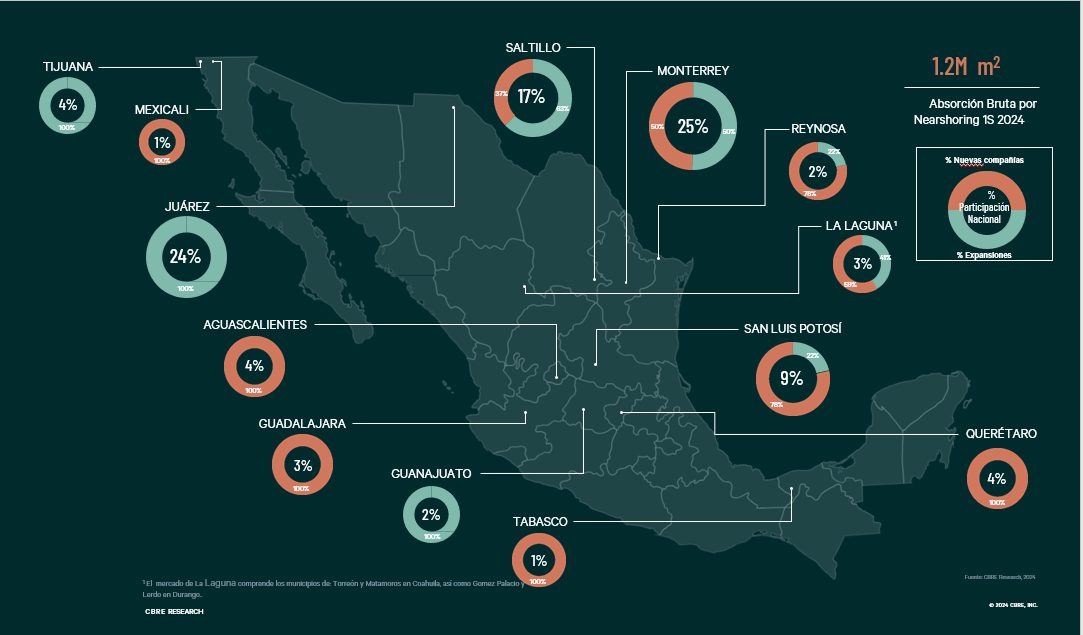
CBRE Mexico's third-quarter 2024 report indicates that demand for space linked to nearshoring reached 1.7 million square meters, an increase of 14 % compared to the previous year (Source: Political Index).
In addition, the first few months of 2025 saw a surge in projects. Fibra MTY, an industrial real estate trust, announced investments totaling 400 million dollars, regaining the momentum that had been slowed by tariffs (Source: El País).
These developments create hundreds of thousands of jobs—in both operational and specialized roles—thereby strengthening the Mexican economy.
Source: CBRE Mexico 2025
The most sought-after skills: logistics, international trade, and technical skills
Gaps in technological and specialized talent
According to ManpowerGroup, Mexico will face a 77 % IT talent shortage by 2025, exceeding the national average. Roles in AI, advanced analytics, automation, and software development are the most affected. EY estimates that only 1,100 people meet the specialization criteria in AI and data—less than % of the total required—and this number would need to be multiplied by seven by 2028 (Source: Mexico Business News).
The Importance of Proficiency in Technical English as a Competitive Advantage
The Functional English It is no longer just an accessory—it is now essential. Only the 14 % among Mexican professionals has an advanced level, which limits opportunities in sectors such as advanced manufacturing, logistics, global trade, and technical audits. According to Juan Santillán, director of Berlitz Mexico:
“70 % of the highest-paying job openings… are related to the English language… and enable people to join globalized industries” (Source: Mexico Industry).

Infrastructure and technologies as operational support for talent
Transportation as the Backbone of Foreign Trade
In 2024, truck transportation between Mexico and the U.S. moved more than 839 billion dollars, with growth of 5.1 % compared to 2023. In Mexico, land transportation accounted for the 81 % of total household load and generated more than 1.2 million direct jobs as of the third quarter of the year (Source: Mexico Industry, T21).
Logistics Technology: From the IoT to Blockchain
Adopting IoT, artificial intelligence, blockchain, and advanced systems makes it possible to optimize routes, monitor cargo in real time, and streamline customs procedures. However, only the 46 % from Mexican companies says it is open to incorporating them, and many routes require modernization (Source: T21).
Strategies for Building Competitive Talent in a nearshoring Environment
-
Continuing Education and Academic Partnerships
Offering flexible, up-to-date bachelor's degrees in International Trade and Business allows professionals to update their skills without taking time off from work (Source: Political Index)
-
Certification and Public-Private Partnerships
Expanding the CONOCER standards to include new profiles and collaborating with associations such as ANIERM, Amacarga, and CANACAR helps align training with the sector’s actual needs (Source: The Logistics World)
-
Bilingual and Applied Technical Training
Investing in technical English programs can boost revenue and employee retention; functional proficiency in the language increases salaries by 30 to 50 % (Source: Mexico Industry)
-
A technological approach from the inside
Companies should promote the use of smart systems, digital traceability, and geospatial analysis to develop critical, safe, and efficient operators (Source: The Logistics World)
Mexico Faces a New Era of Competitiveness
The rise of the nearshoring is driving demand for specialized talent in international trade, logistics, and engineering, and offers clear paths to tackling challenges through training, certification, and innovation.
Would you like to know how your company can align itself with these trends and capitalize on them in today's investment climate? In Grupo MOZ We have the expertise in logistics, transportation, and international trade to support your business during this new phase of expansion.